Challenged-Team Match-Condition Rule
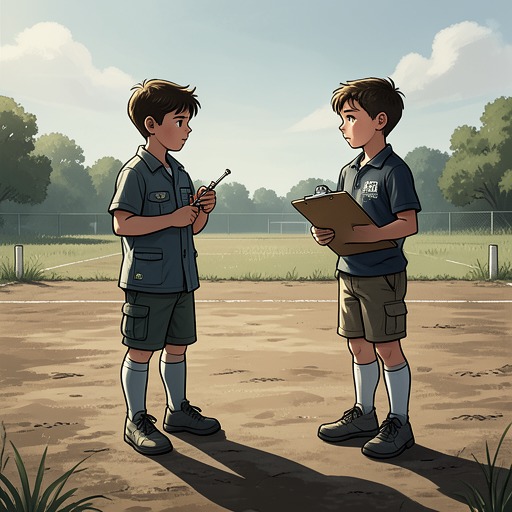
Kevin the Star StrikerThe Challenged-Team Match-Condition Rule is the principle that the team being challenged may determine the terms of the contest. In the confrontation between the Wild Bunch and the Unbeatables, the rule transforms a dispute over access to the soccer field into a formal match whose conditions expose the difference between legitimate competitive authority and intimidation. The rule is presented as part of the language of duels, but its application becomes a test of whether a game can remain a game when one side controls the framework.
Origin in the Field Dispute
The rule grows out of the Unbeatables’ seizure of the soccer field. Mickey the Bulldozer announces that the field belongs exclusively to his group and orders the Wild Bunch to leave. Kevin refuses to accept permanent exclusion and offers a two-week deadline before the Wild Bunch returns for a soccer challenge. His proposed terms are reciprocal: if the Wild Bunch loses, the Unbeatables keep the field; if the Wild Bunch wins, the Unbeatables must leave and the field returns to the Wild Bunch. Kevin’s challenge therefore gives the conflict a defined object, a time limit, and a condition for restoring possession rather than leaving the dispute to uncontrolled violence.
The rule’s authority is stated most explicitly when Mickey declares that the challenged side chooses the weapons. In the soccer context, “weapons” means the match conditions. Mickey treats this privilege as proof that the Unbeatables can dictate the contest because the Wild Bunch has challenged them on their own occupied field. His control over the setting is already unequal: the Unbeatables have possession of the field, numerical confidence, and physical dominance before the match begins.
Conditions Chosen by the Unbeatables
Mickey uses the rule to make the opening as difficult as possible for the Wild Bunch. He decides that the Wild Bunch will kick off while facing the sun, forcing them to play with the sunlight in their eyes. He also refuses to wait for Kyle, leaving the Wild Bunch to begin seven against six, and mocks the team’s objection that the imbalance is unfair. The conditions thus combine environmental disadvantage with a numerical one.
Mickey further chooses a ten-goal format, proposing that play continue until one team has scored ten goals. He presents the arrangement as a way to finish quickly because he has plans later, but the format also fits his confidence that the Unbeatables can overwhelm their opponents. The whistle is already in his possession, and he starts the match before the Wild Bunch has finished moving into position. The rule therefore gives him not only a formal choice of conditions but practical control over timing and procedure.
The match also reveals how the Unbeatables stretch the meaning of permissible play. When the Grim Reaper pushes Tyler to the ground and then strikes Julian in the eye with an elbow, Mickey declares that body contact is allowed. This additional condition removes the ordinary boundary between forceful play and foul play. Under the Unbeatables’ interpretation, the rule becomes a license for physical intimidation, helping Mickey’s team build a five-goal lead in seven minutes while Julian, Tyler, and Kevin are left injured on the grass.
The Wild Bunch’s Counter-Conditions
Although the Unbeatables control the initial terms, the Wild Bunch does not surrender the idea that conditions can be negotiated. After the disastrous opening, Roger proposes a concrete consequence: the losing team must repair Larry’s lemonade stand. Mickey initially laughs at the proposal, but the condition changes the meaning of defeat. Losing will no longer mean only surrendering the field; it will also require the defeated side to take responsibility for damage connected to the wider conflict.
The repair condition contrasts with Mickey’s chosen advantages. His terms privilege speed, spectacle, sunlight, numbers, and bodily force. Roger’s term introduces accountability and restoration. The contest is still adversarial, but its outcome now has a practical consequence beyond victory gestures. The soccer match becomes a mechanism for deciding not only who controls the field but who must repair what has been harmed.
The Wild Bunch also responds to Mickey’s conditions through coordinated play rather than matching his aggression. After the new condition is accepted, the team gathers shoulder to shoulder and cries, “ONE, TWO, THREE WILD!” Kevin then passes to Alex, Alex plays back to Tyler, Tyler sends the ball right to Danny, and the sequence continues through Kevin and Joey. The movement briefly unsettles the Unbeatables, showing that the challenged team’s answer need not be another imposed rule: it can be collective discipline within the rules that remain.
Function and Significance
The Challenged-Team Match-Condition Rule gives the book a formal structure for a conflict that begins as simple occupation and threat. It explains why Mickey can set apparently arbitrary terms, including playing into the sun, beginning before Kyle arrives, playing to ten goals, and permitting body contact. At the same time, Kevin’s original wager and Roger’s repair condition prevent the rule from becoming a complete surrender of justice. Conditions can be chosen by the powerful, but their meaning remains contestable through courage, teamwork, and consequences.
The rule also exposes the difference between the Unbeatables’ version of strength and the Wild Bunch’s. Mickey equates strength with making opponents play under conditions designed to humiliate and injure them. Larry, by contrast, tells the Wild Bunch that fear can be a source of strength, and the team’s eventual response is organized through trust and passing rather than bravado alone. The rule’s dramatic importance lies in this tension: control of the game’s framework appears to guarantee victory, yet the imposed conditions cannot determine how the challenged team will act inside them.
As a recurring principle, the rule links the field’s physical boundaries to a wider social order. Whoever controls the field claims the right to define participation, timing, acceptable contact, and the price of defeat. The Wild Bunch–Unbeatables match therefore tests whether authority comes from possession and intimidation or from conditions that can produce a meaningful and accountable contest. The repair obligation, placed beside the ten-goal demand and the body-contact permission, makes the rule part of a larger movement from occupation toward a negotiated resolution.